
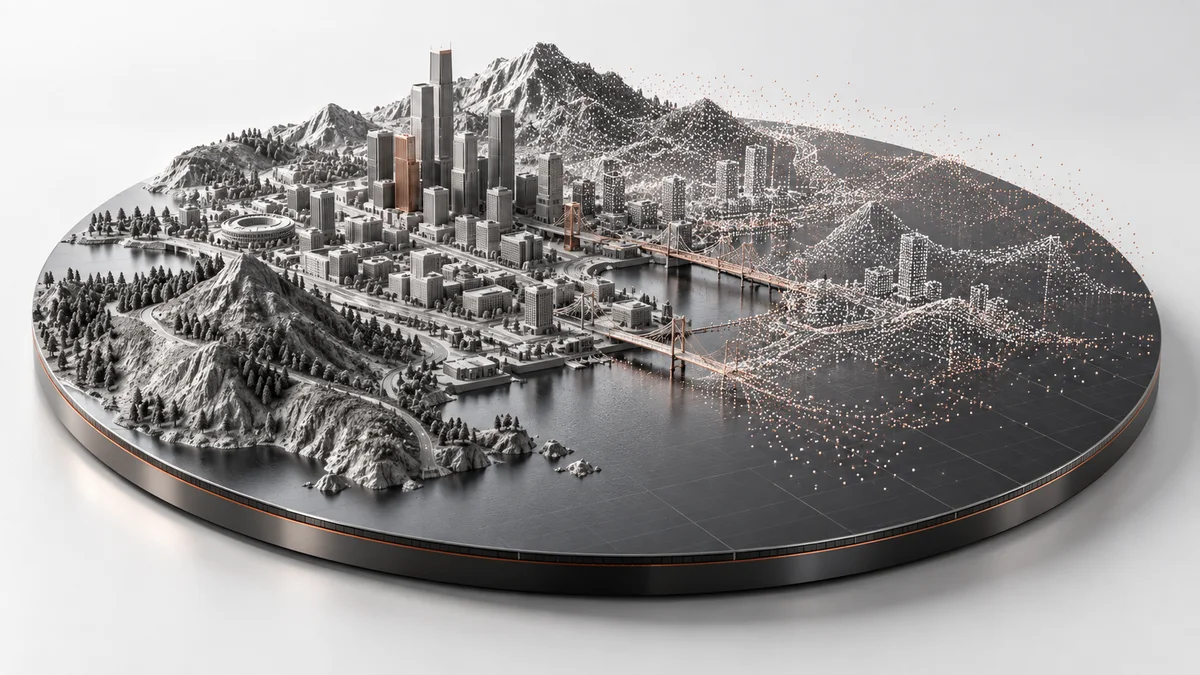
Text has been the most visible interface to generative AI. A room, a factory floor or a moving vehicle presents a different problem: the system must reason about space, scale and change. AMD’s latest acquisition announcement puts that problem closer to the centre of the compute discussion.
What AMD announced on September 28
AMD announced a definitive agreement to acquire World Labs in an approximately $8.2 billion all-stock transaction. The company expects it to close by the end of 2026, subject to regulatory approvals and customary conditions. The announcement concerns a proposed acquisition, not a completed deal. World Labs, co-founded by Fei‑Fei Li, develops spatial AI models that generate, reconstruct and simulate interactive three-dimensional environments from inputs including text, images and video. AMD’s announcement sets out the intended direction. Its SEC filing records the agreement entered into on September 26 and disclosed on September 28.
A convincing scene is not a reliable environment
My interpretation is that the data problem deserves at least as much attention as the rendering. A generated environment may look coherent while still being unsuitable for measurement or planning.
Consider a hypothetical warehouse simulation. A visually plausible aisle is not enough. Its width, coordinate system, obstacles and relationship to the actual floor plan matter. If a downstream process treats artistic detail as measured geometry, the error becomes operational.
Keep a clear distinction between observed data, inferred structure and generated content. Record the origin of each input, the transformation applied and the version used. Where a dimension is unknown, preserve that uncertainty instead of filling it with a confident-looking value.
Spatial data needs a shared frame of reference
Traditional reporting often fails because two teams define a metric differently. Spatial workflows add another layer: two datasets can describe the same place in different coordinate systems, units or time frames.
An engineering checklist should therefore include unit conventions, calibration, timestamps and alignment between sensors or source assets. A scene that was accurate yesterday may not represent a space that changed today.
Version the environment alongside the assumptions. If an evaluation improves, you need to know whether the model changed, the scenario became easier or the underlying geometry was corrected. Without that record, a performance chart can conceal the actual reason for progress.
Separate development scenarios from held-out evaluation environments. Repeatedly adjusting a simulation to fit the system under test makes the final result less informative.
Treat the acquisition as a signal, not a delivery schedule
A corporate announcement is evidence of strategic intent. It does not establish that a particular integration, hardware optimisation or commercial product will arrive on a date you can plan around.
For teams considering spatial AI, a small pilot should answer a narrow question: does this environment help evaluate one task more reliably than the current method? Compare simulation outcomes with measured observations where possible. Document gaps rather than treating visual quality as validation.
Procurement decisions should depend on demonstrated capability, supported formats, export options and a credible evaluation process. Keep an exit path for your data and scenario definitions.
The practical opportunity is to make complex environments easier to test. The practical risk is mistaking a persuasive reconstruction for ground truth. That distinction will matter long after the acquisition headline moves on.
Reported news falls within September 28–29, 2026. The acquisition remains subject to closing conditions. Warehouse examples and data recommendations are analytical illustrations, not product claims or investment advice.